
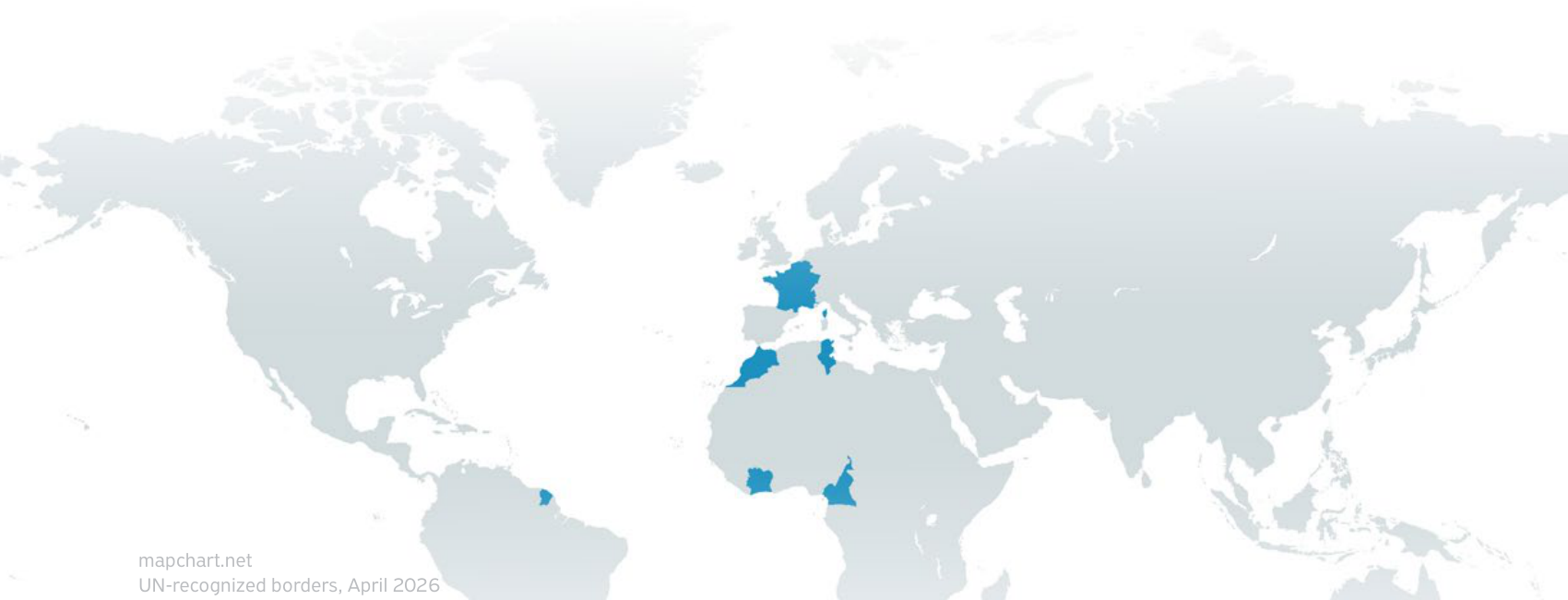
Justification for the choice of source countries for international recruitment in early childhood education
As mentioned previously, we selected six source countries: Belgium, Cameroon, Côte d’Ivoire, France, Morocco, and Tunisia. This choice is based on a combination of factors related to the availability of recognized training programs, the language proficiency of graduates, the alignment of their professional qualifications with Canadian expectations, and the logistical capacity to participate in a structured and ethical migration process.
These six countries were selected because they show:
- Sufficient and structured training capacity in the field of early childhood education;
- Candidates with an adequate command of French and a functional command of English that will facilitate integration;
- A potential for collaboration with Canada that has already been initiated or that may be developed;
- Clearly defined issues regarding the recognition of qualifications that can be addressed with institutional partners.
This choice aims to ensure an ethical, fair, and realistic recruitment process, with well-trained candidates capable of contributing to the early childhood sector in Canada.
Note on the information given in sections 5.1 to 5.6
- The equivalencies presented are based on the practices of recognized evaluation organizations (e.g., WES) and should be interpreted as indicative. Equivalency decisions are the responsibility of the provincial and territorial authorities.
- ECTS credits (from the European Credit Transfer and Accumulation System) are a European unit of measurement for academic workload, where 60 credits correspond to one year of full-time study. Therefore, a program of 180 ECTS credits is generally equivalent to three years of post-secondary study.
| Factors | Belgium  | Cameroon  | Ivory Coast  | France  | Morocco  | Tunisia  |
|---|---|---|---|---|---|---|
| Relevant training system | Institutions granting qualifications for preschool teachers, bachelor’s degrees in early childhood education and care, etc. | Diverse range of training courses: 10 institutions offering certificates of teaching aptitude and post-secondary qualifications | Recognized State Diploma: Diplôme d’État d’éducateur préscolaire (DEP) offered by l’Institut national de formation sociale | A wide range of training opportunities: 37 institutions offering qualifications such as the DEEJE or the CAP AEPE | Well-structured training offered: 3 professional licenses (OFPPT) | 11 institutions offering, in particular, le Brevet de technicien supérieur (BTS) éducateur et éducatrice petite enfance |
| Proficiency in French | Excellent: 76% (OIF) | About 60% | 60% for educated individuals | High: 97% (OIF) | About 60% | Good: 63% |
| Proficiency in English | Intermediate: estimated between 18 and 24% (Eurostat) | 25%, of which 13% are bilingual | Intermediate: 23% | Intermediate: 30 to 35% | 20 to 30% | 20 to 40% |
| Work Holiday Visa* | Working Holiday Visa for those aged 18–30, maximum duration of 1 year | Working Holiday Visa for those aged 18–35, maximum duration of 2 years | ||||
| PISA Reading Score (2022) | High: 479 | 477 | 339 | 361 in 2015 | ||
| PISA Math Score (2022) | 489 | 474 | 365 | 367 in 2015 | ||
| PISA Science Score (2022) | 491 | 487 | 365 | 386 in 2015 | ||
| HDI | Very high: 0.951 | Average: 0.587 | 0.710 | 0.746 | ||
| Benefits | Programs often well aligned with European and Canadian standards | A young and trained workforce, very open to professional migration | Attractiveness: a stable country with a strong tradition of training in the early childhood sector | Training standards are well-known and closely aligned with Canadian expectations, despite the challenges related to the CECE in Ontario | Developing partnerships, a pool of well-trained candidates, and strong cultural and linguistic ties with the Canadian Francophonie | Compatible linguistic and educational profile: good balance between technical and academic training |
Note : The Canada Working Holiday Visa stems from bilateral youth mobility agreements concluded between Canada and several countries, including France and Belgium.
5.1 Belgium
Context: culture, economy, politics
Belgium is distinguished by its institutionalized cultural and linguistic diversity, based on the coexistence of its Francophone, Dutch-speaking, and German-speaking communities. These multiple communities influence educational systems, professional practices, and regulatory frameworks, particularly in the areas of training and certification. A culture of social dialogue, collaboration, and shared governance shapes public policies and relationships between institutional actors.
Economically, Belgium has an open and highly service-based economy, supported by logistics, specialized industry, and the presence of European institutions. Investments in training, labour force qualifications, and innovation are central drivers of economic and social development.
Politically, the country is a federal constitutional monarchy, characterized by a strong decentralization of responsibilities to the regions and communities. In education, it is primarily the linguistic communities that undertake these responsibilities; this results in distinct educational policies, and influences the structuring of qualifications and the mechanisms for recognizing them.
The participation rate in ECE is very high, with approximately 95% of children over the age of 4 enrolled in pre-primary education, reflecting a widely accessible and institutionalized system.
Terminology
When analyzing the profiles of people trained in Belgium, it is crucial to verify that they have taken courses and completed practical internships specifically in ECE, in order to facilitate the recognition of their training in the provinces and territories of Canada.
In Belgium, the following terms refer to distinct levels of training within the education system:
- Bachelier: Corresponds to an undergraduate bachelor’s-level degree, usually obtained after three to four years of study;
- Brevet: Refers to a college-level diploma or certificate qualification, or a specialized professional certification, depending on the sector;
- Certificat: Most often refers to a professional qualification or a competency certification;
- Classification A1: Level of training that refers to post-secondary training;
- Classification A2: Level of training that refers to a qualifying secondary school training.
This terminology differs from Canadian usage and must be interpreted rigorously, particularly in relation to the content of the training and internships completed.
ECE training system
In Belgium, early childhood education training is traditionally based on a continuous annual program, covering the entire academic year from September to June. If a student fails a course or a mandatory internship, they must repeat the entire year.
Pre-primary education is compulsory from the age of five, although children can attend preschool free of charge from the age of two and a half.
Recent reforms, particularly in Wallonia since 2023, have strengthened the training requirements for teaching staff. Although non-school child care settings can still recruit staff with secondary or professional qualifications, pre-primary teachers must now hold a master’s degree.
Qualifications offered
Qualification professionnelle d’ordre secondaire (services de garde) [Secondary professional qualification (child care settings)]
Le Certificat de qualification de puériculteur ou puéricultrice is obtained following a four-year professional program (meaning the 9 compulsory years of school plus a 4-year professional program), thus combining general education and practical training in a child care setting.
L’agente ou agent d’éducation qualification is similar, following a program of approximately three years (meaning the 9 compulsory school years plus a 3-year program), with a more specialized focus.
Modular programs also exist in adult education (continuing education), including the Certificat d’auxiliaire de l’enfance ou d’éducateur. These programs, often lasting one to two years, now require the Certificat d’enseignement secondaire supérieur (CESS) to work in child care settings.
Bachelier en accueil et éducation du jeune enfant (AEJE) [Bachelor’s degree in early childhood education and care]
This recently introduced three-year program (180 ECTS credits) aims to enhance the professionalization of the sector. It includes courses in pedagogy, developmental psychology, health, and legislative frameworks, as well as practical internships. Graduates can work in child care settings but are not qualified to teach in pre-primary schools.
Master en enseignement – section 1 (préscolaire et primaire) [Master’s degree in education – section 1 (preschool and primary)]
Since 2023, this has been the professional qualification required to teach in pre-primary schools. It is an integrated four-year program (240 ECTS), combining higher education and university training.
Comparability with Canadian requirements
Belgian qualifications have a clear structure by level of education, ranging from secondary professional qualifications to university degrees.
Secondary-level programs, such as the Certificat de qualification de puériculteur ou puéricultrice, are generally comparable to a Canadian high school diploma with a professional specialization. Adult education programs are more difficult to evaluate or categorize and require individualized analysis.
Le Bachelier en AEJE is generally comparable to a Canadian three-year bachelor’s degree, while le Master en enseignement corresponds to a combination of bachelor’s and master’s degrees in the Canadian system.
However, as in other countries studied, gaps can be observed with regard to specific training related to children under 3 years of age and the documentation of practical internships.
Criteria and obstacles to the recognition of qualifications
The recognition of Belgian qualifications is based primarily on the analysis of the total duration of the training, the number of theoretical and practical hours involved, as well as the quality and supervision of the internships.
The main obstacles include the complexity of the education system (the linguistic communities), the coexistence of classification levels (A1 and A2), and the variability of training pathways in adult education.
Challenges may also be related to documenting internships and interpreting qualification designations in a Canadian context.
Best practices and ways for collaboration
Developing formal partnerships between Belgian institutions and Canadian authorities is a good practice to facilitate access to standardized program descriptions and competency benchmarks.
The use of equivalency charts comparing Belgian qualifications with corresponding Canadian levels, as well as the development of targeted bridging training (particularly for infants, regulatory frameworks, and health and safety), would strengthen transparency and accelerate the processes for recognition of qualifications.
5.2 Cameroon
Context: culture, economy, politics
Cameroon is characterized by a rich cultural, linguistic, and religious diversity resulting from the coexistence of local traditions and Francophone and Anglophone influences. The extended family and community networks play a central role in the socialization and education of young children, with a strong emphasis on intergenerational transmission, respect for authority, and social cohesion. These factors influence educational practices from early childhood, particularly in the areas of socialization, language, and integration into the school environment.
Economically, the country relies on a mixed economy combining agriculture, natural resources, services, and a significant informal economic sector. Development policies emphasize professional training and skills development to support employability and the quality of social services, including in the early childhood education sector.
Politically, Cameroon is a centralized presidential republic. The institutional framework is marked by matters related to decentralization, governance, and national cohesion, particularly in the Anglophone regions. These dynamics influence the organization of educational policies, the structuring of training systems, and the mechanisms for professional certification.
The country has seen a notable increase in preschool enrollment rates in recent years, although significant challenges remain, particularly in terms of access, infrastructure, and the availability of qualified teachers, especially in rural areas and regions that are affected by conflict.
Terminology
In Cameroon, the terms certificat, brevet, and diplôme refer to distinct levels of training within the Francophone and Anglophone education systems. The terminology may vary depending on the relevant ministry (basic education, secondary education, employment and vocational training) or the institution that delivers the training.
In Anglophone contexts, titles such as a Certificate or Diploma in Early Childhood Education are commonly used. This terminological diversity necessitates rigorous interpretation when analyzing the equivalency of international qualifications, particularly to distinguish secondary-level professional qualifications from post-secondary qualifications.
ECE training system
ECE training is offered by public and private institutions, including the écoles normales d’instituteurs (ENI) [teachers training colleges], professional training centres, and specialized early childhood institutes. Francophone and Anglophone pathways coexist, but sometimes with different program structures and different competency benchmarks.
The regulatory framework aims for a gradual harmonization of certifications, but differences remain between programs in terms of duration, number of hours, standardization of content, and formalization of supervised internships.
The standard professional qualification for preschool teaching in the Francophone system is the Certificat d’aptitude pédagogique d’instituteurs de l’enseignement maternel et primaire (CAPIEMP), while the Anglophone equivalent is the Teachers Grade One Certificate. These programs are generally offered in teachers training colleges for general education (ENIEG, écoles normales d’instituteurs de l’enseignement général), under the supervision of the Ministry of Secondary Education.
Qualifications offered
Certificat d’aptitude pédagogique d’instituteur de l’enseignement maternel et primaire (CAPIEMP)
This diploma is the main professional qualification for teaching in preschool and primary school. It is a post-secondary program generally lasting two years (13+2, after a recent reform), accessible after a high school diploma or equivalent qualification, with an entrance exam.
There is also an alternative three-year program (10+3) for those with a lower secondary school diploma. Both programs include practical placements in schools and a final national examination.
Teachers Grade One Certificate
This is a qualification equivalent to CAPIEMP in Anglophone regions, with similar requirements in terms of duration, pedagogical training, and supervised internships.
University programs in ECE
Some universities, in particular the University of Bamenda, offer three-year bachelor’s degree programs in early childhood education, intended for more advanced or supervisory roles.
Other university pathways, such as the Diplôme de professeur de l’enseignement (DIPET I) or the Licence en sciences de l’éducation, may also include components related to early childhood, although this is not always a distinct specialization.
Comparability with Canadian requirements
Analysis of Cameroonian ECE programs reveals a conceptual closeness between the Francophone and Anglophone approaches in basic pedagogy, child development, and integration of practical internships.
Post-secondary programs like the CAPIEMP (13+2) are generally comparable to Canadian college training, while the university pathways can correspond to bachelor’s degrees.
However, differences can be observed with regard to the standardization of competency benchmarks, supervised internship hours, and specific training related to infants and children under 2 years of age, training that is often explicitly required in several Canadian provincial frameworks.
Criteria and obstacles to the recognition of qualifications
The recognition of Cameroonian qualifications is based primarily on an evaluation of the total duration of training, the number of hours of instruction, the structure of the programs, and the number of hours of supervised internships. Particular attention is paid to the standing of the institution offering the training, and the required admittance level.
Primary obstacles include the diversity of certifying authorities, the coexistence of Francophone and Anglophone pathways, and the variability of qualification designations. Difficulties can also arise from the multiple pathways (post-secondary and secondary), inconsistent documentation of training programs, and the fact that some teachers practice without specific qualifications, particularly in rural areas.
Best practices and ways for collaboration
In order to facilitate the recognition of qualifications and professional mobility, it is recommended to strengthen the standardization of program descriptions, in particular by the preparation of detailed course plans, competency matrices, and internship certificates specifying the duration, level of supervision, and age groups supervised.
Developing institutional partnerships between Cameroonian early childhood training institutions, Canadian organizations that evaluate qualifications, and Canadian post-secondary institutions could foster a better understanding of each other’s standards. Implementing targeted bridging programs, holding blended participant webinars, and having virtual professional discussions would also be promising ways to reduce the identified gaps and accelerate the processes for the recognition of qualifications.
5.3 Ivory Coast
Context: culture, economy, politics
Côte d’Ivoire is characterized by significant cultural and ethnic diversity. French is the official language in Côte d’Ivoire and the country has strong community traditions. The values of solidarity, respect for hierarchy, and intergenerational transmission play a role in structuring social and educational practices, particularly in early childhood care.
Economically, the country boasts one of the most dynamic economies in West Africa, driven by agriculture, particularly the cocoa sector, as well as commerce, services, and infrastructure. Development policies increasingly emphasize professional training and improved access to preschool education.
Politically, Côte d’Ivoire is a presidential republic engaged in a process of institutional consolidation. Recent reforms aim to strengthen governance, stability, and the effectiveness of social policies, including in the education and child protection sectors.
However, access to ECE remains limited, with low school enrollment rates and significant disparities between urban and rural areas, as well as a lack of qualified teachers, which directly influences the structuring of training pathways.
Terminology
In Côte d’Ivoire, the terms certificat, brevet, and diplôme refer to distinct levels of training within the educational and professional training system. A baccalauréat refers to the national diploma awarded upon completion of secondary education that grants access to higher learning.
The names used by public, private, or faith-based centres may vary, and this requires rigorous interpretation when analyzing the equivalency of international qualifications, particularly to distinguish a secondary professional qualification from a post-secondary qualification.
ECE training system
ECE training is offered by a network of public and private institutions, including teacher training colleges, professional training centres, and community or faith-based organizations. Programs fall under the jurisdiction of different ministries, which can lead to variations in curriculum structure, training duration, and the formalization of supervised internships.
The regulatory framework aims for a gradual harmonization of certifications, but differences remain between academic (college and university) and professional training pathways, particularly with regard to competency benchmarks, standardization of number of hours, and documentation of practical experience.
The standard professional qualification for teachers in ECE is the Diplôme d’État d’éducateur préscolaire (DEP); admission to these programs requires a baccalauréat or comparable qualification as well as passing an entrance exam.
In practice, a significant proportion of preschool staff, particularly in the private sector, do not always have specific qualifications in early childhood education, which reflects the structural constraints of the system.
Qualifications offered
Diplôme d’État d’éducateur préscolaire (DEP)
The DEP is the main qualification in ECE. The program generally takes three years, with the possibility of reducing it to two years depending on prior learning. It combines theoretical instruction (pedagogy, child psychology, public health, educational activities) and practical placements in real-world settings.
This qualification is offered by the National Institute for Social Training (INSFS, Institut national supérieur de formation sociale), the main public institution specializing in this field, and is delivered by the Ministry of Employment and Social Protection.
Diplôme d’État d’éducateur préscolaire adjoint (DEPA)
This two-year program, intended for individuals who have a high school diploma, includes theoretical courses and practical internships. Combined with experience, this program allows admission to the higher-level DEP qualification.
Community Programs (Éducateur préscolaire communautaire – EPC)
These short-term training programs (approximately 3 months) are designed to address teacher shortages, particularly in rural areas. They focus on practice and on quick integration into preschool settings.
Comparability with Canadian requirements
Analysis of Ivorian ECE programs reveals a conceptual similarity with Francophone approaches to basic pedagogy, child development, and the integration of practical internships. Professional training programs emphasize field experience, while academic programs offer a more structured foundation in educational planning and classroom management.
The DEP is generally considered equivalent to a three-year bachelor’s degree in ECE in the Canadian context, making it the most favourable designation in terms of the recognition of ECE qualifications.
However, differences can be observed with regard to the standardization of competency benchmarks, supervised internship hours, and the specific training related to infants and children under 2 years of age, training that is often explicitly required in several Canadian provincial frameworks.
Criteria and obstacles to the recognition of qualifications
The recognition of Ivorian qualifications in ECE is based primarily on an evaluation of the total duration of the training, the number of hours of instruction, the program structure, and the number of hours of supervised internship. Particular attention is paid to the standing of the institution offering the training and to the required admittance level.
Principal obstacles include the diversity of certifying authorities, the variability of qualification designations, and the incomplete documentation of training pathways. Difficulties can also arise from the existence of short-term or non-standardized training programs, as well as from a lack of specific competencies for some staff in preschool settings.
Best practices and ways for collaboration
In order to facilitate the recognition of qualifications and professional mobility, it is recommended that the formalization of programs be strengthened, in particular by preparing detailed course descriptions, competency matrices, and standardized internship certificates.
Developing institutional partnerships between Ivorian early childhood training institutions, Canadian organizations that evaluate qualifications, and Canadian post-secondary institutions could foster a better understanding of each other’s standards. Implementing targeted bridging programs, holding blended participant webinars, and having professional discussions would also be promising ways to reduce identified gaps and accelerate the processes for the recognition of qualifications.
5.4 France
Context: culture, economy, politics
France is characterized by a cultural identity that is strongly structured around language, secularism, and republican values, with a central place given to education and equal access to public services. Social and educational policies are of great importance, and early childhood is considered a crucial stage of development, both educationally and socially.
Economically, France has a diversified economy based on industry, services, agriculture, and innovation. The country invests heavily in initial training and continues the training in the development of workforce skills in order to meet the needs of the labour market and to support the quality of services, particularly in the health, education, and early childhood sectors.
Politically, France is a semi-presidential republic characterized by a strong central state. National regulatory frameworks oversee training, delivery of qualifications, competency benchmarks, and the organization of professions, which promotes the uniformity of standards across the entire country, including for professions related to early childhood.
Terminology
In France, the following terms refer to distinct levels of qualification:
- The Certificat d’aptitude professionnelle – Accompagnant éducatif petite enfance (CAP AEPE) corresponds to a basic professional diploma, generally obtained after secondary school and often recognized as a high school diploma in Canada;
- The diplômes d’État are regulated and nationally recognized professional certifications;
- A licence refers to an undergraduate university degree, usually obtained after three years of post-secondary studies;
- The Bachelor universitaire de technologie (BUT) – Carrières sociales/parcours liés à l’intervention sociale is a French higher education designation offered mainly in the Instituts universitaires de technologie, which are attached to universities.
This terminology is generally closer to the classifications used in Canada, but still requires rigorous interpretation, particularly to distinguish qualifications oriented towards child care (providing care and supervision) from those focused on educational instruction.
ECE training system
ECE training in France is governed by a highly standardized framework, based on national qualifications and competency benchmarks. It is offered by professional training institutions (accredited centres and institutes) and post-secondary institutions (universities and institutes). Programs generally include theoretical instruction in child development, pedagogy, health and safety, as well as mandatory internships in child care settings (child care centres, preschools, and mother and child protection services).
Preschool is an integral part of the school system and is compulsory for children aged 3 to 6, with very high attendance rates. The schools, mostly public, must meet uniform national educational requirements, including those related to the qualifications of teaching staff.
This standardized national framework makes it easier to understand the training pathways and to make international comparisons, particularly thanks to the available documentation on expected competencies and certification requirements.
Qualifications offered
Certificat d’aptitude professionnelle – Accompagnant éducatif petite enfance (CAP AEPE)
This professional qualification focuses on the care and support of young children, including skills in hygiene, safety, child development, and early years activities. It includes a practical training component and approximately 14 weeks of mandatory internships. The duration generally varies between 9 months and 2 years, depending on the training program.
Diplôme d’État d’auxiliaire de puériculture (DEAP)
This diplôme d’État qualification focuses on care, support, and prevention, including intervention in the early years, particularly in health care and child care settings. It includes theoretical training and supervised internships, generally lasting approximately one year.
Diplôme d’État d’éducateur de jeunes enfants (DEEJE)
This post-secondary diplôme d’État focuses on educational intervention, the overall development of the child, partnership with families, and the design of educational projects. The program typically lasts three years (180 ECTS credits) and includes approximately 1,500 hours of theoretical training and 2,100 hours of practical training in various settings.
Bachelor universitaire de technologie (BUT) – Carrières sociales/parcours liés à l’intervention sociale
This structured post-secondary training includes courses in the humanities, intervention, methodology, and professional practice. Its relevance to early childhood education depends on the individual’s pathway and the internships completed with young children.
Licence et licence professionnelle – Sciences de l’éducation/métiers de la petite enfance
These university qualifications, which provide a theoretical foundation in pedagogy, developmental psychology, and educational policy, are sometimes completed with a specialization in early childhood and with internships. Their relevance depends on the modules chosen and the level of supervised practice.
Master en Métiers de l’enseignement, de l’éducation et de la formation (MEEF) – Professorat des écoles (enseignement préscolaire)
This postgraduate university qualification is required to teach in public preschools. It includes two years of study after a licence (see above) and is completed with a national competitive examination: le Concours de recrutement des professeurs des écoles (CRPE).
Comparability with Canadian requirements
An analysis of French training content reveals a conceptual similarity with Canadian approaches, particularly in terms of pedagogy, child development, inclusion, and structuring of internships.
The diplômes d’État, in particular, are distinguished by detailed competency benchmarks and clearly documented internship requirements, which facilitates equivalency analysis. The DEEJE is generally the most widely recognized as equivalent to a Canadian post-secondary program, while the CAP AEPE and the DEAP are often considered secondary-level or basic professional qualifications.
However, differences may appear, depending on the Canadian province/territory, particularly in relation to certain specific requirements (e.g., health and safety, local regulations, first aid, pedagogy of infants and very young children) or on the distinction between care-oriented professions versus educational instruction.
Criteria and obstacles to the recognition of qualifications
The recognition of French qualifications in ECE is based primarily on the analysis of the total duration of the training, the level of qualification, the number and type of supervised internships, as well as the equivalency between the competency benchmarks and the Canadian provincial/territorial requirements.
Potential obstacles include differences in the structure of the professions (care vs. education), differences between professional qualifications (e.g., CAP) and post-secondary qualifications (e.g., DEEJE and licence), and the need to demonstrate locally required competencies. In some cases, recognition may be conditional upon additional training, validation of internship hours, or proof of recent experience in child care settings.
Best practices and ways for collaboration
To facilitate recognition and professional mobility, it is recommended to systematically provide detailed course descriptions, competency benchmarks, and standardized internship certificates that specify the duration, level of supervision, and age groups concerned.
Developing partnerships between French early childhood training institutions, Canadian organizations that evaluate qualifications, and Canadian post-secondary institutions could foster a better understanding of each other’s standards. Implementation of bridging training programs, blended participant webinars, and information-sharing mechanisms would help reduce timelines, ensure accurate equivalency evaluations, and support professional integration.
5.5 Morocco
Context: culture, economy, politics
Morocco is characterized by a multicultural identity stemming from Amazigh, Arab, Andalusian, and African heritages, where language, religion, and family play a structuring role in social life. The values of hospitality, respect for authority, and community cohesion influence educational practices and the transmission of knowledge from early childhood.
Economically, the country has a diversified and modernizing economy based on agriculture, tourism, manufacturing, services, and foreign investment. Recent public policies emphasize workforce skills development, professional training, and improving the quality of educational services, including preschool services.
Politically, Morocco is a constitutional monarchy in which the king plays a central role in strategic direction and major reforms. The institutional framework promotes stability and the implementation of sectoral policies, particularly in education and social protection, within a context of ongoing reforms aimed at strengthening access, quality, and governance in the education system.
However, the country has a relatively low rate of participation in ECE (29.8% in 2024) and faces a significant shortage of qualified teaching staff with initial training in early childhood education. This directly influences the structure and diversity of training pathways.
Terminology
In Morocco, the following terms refer to distinct levels of qualification
- Bachelier: Generally, refers to a student who has obtained the baccalauréat, a national qualification marking the end of secondary studies and granting access to higher education. This term differs from Canadian usage, where bachelier refers instead to a post-secondary qualification;
- Licence d’éducation: Basic qualification for public education, gradually replacing short-cycle programs;
- Certificat de qualification pédagogique (CQP): The CQP is a post-secondary professional certification awarded as part of teacher and educational staff training. It does not necessarily correspond to a full university degree. Its level and recognition vary according to several criteria, such as the duration of the program, the number of internship hours, and the specialization completed.
ECE training system
ECE training in Morocco has been strengthened and professionalized in recent years. The training is offered by public and private institutions, under the supervision or authorization of national education authorities. Notably, ECE training is provided by the Institut royal de formation des cadres (IRFC), in collaboration with the Faculté des sciences de l’éducation de l’Université Mohammed V.
Programs are also offered by specialized training centres, such as the Centre Al Manar, which offers courses lasting one to two years, either in person or remotely, as well as by the Institution Tahar Sebti (ITS), whose mission is to strengthen the supply of certified training in the early childhood sector.
The reforms introduced in 2018 strengthened the professionalization of the sector by establishing the licence d’éducation as the basic qualification for public school teachers, gradually replacing short-cycle programs. Teachers must also obtain the two-year Certificat de qualification pédagogique (CQP), which includes theoretical training and a supervised internship in a school setting.
However, a significant proportion of educators, particularly in the private sector, continue to hold a short-cycle professional qualification, which reflects the structural gaps in the system.
Qualifications offered
Licence d’éducation/Licence professionnelle en éducation des jeunes enfants
This three-year (six-semester) post-secondary qualification is offered at teacher training institutions and some universities. It includes courses in pedagogy, child development, and educational management, as well as mandatory internships.
Certificat de qualification pédagogique (CQP)
This two-year postgraduate program is required to teach in the public sector. It combines theoretical instruction with supervised practice in a school setting.
Diplômes de cycle court – Éducatrice de jeunes enfants/éducatrice spécialisée en petite enfance
These programs, lasting approximately two years after a baccalauréat, are offered by private institutes and professional training centres. They include theoretical training and practical internships, and are particularly widespread in the private sector.
Programmes spécialisés (Centre Al Manar, ITS and others)
These varied programs combine theoretical, technical, and practical training, with a strong internship component and an orientation towards inclusion and working in diverse environments.
Comparability with Canadian requirements
An analysis of the training content and teaching modules reveals a conceptual similarity with the approaches used in France and Canada, particularly regarding pedagogy, assessment of child development, and the structuring of internships. The programs are distinguished by a strong theoretical and practical component.
The two-year diplômes de cycle court are generally comparable to a two-year Canadian college qualification, while the licence d’éducation corresponds to a Canadian bachelor’s degree (three or four years), depending on the institution. The CQP can be considered equivalent to a graduate-level qualification, comparable to a master’s degree in certain evaluation contexts.
However, differences can be observed, particularly with regard to specific training related to infants and children under 2 years of age, which is often a required criterion in several Canadian provinces/territories.
Criteria and obstacles to the recognition of qualifications
The recognition of Moroccan qualifications in ECE is based primarily on an analysis of the total duration of the training, the number of hours, the program structure, and the proportion of supervised internships in care settings (as opposed to education settings). Organizations that evaluate qualifications pay particular attention to the standing of the training institution, as well as to the clarity of the competency benchmarks and learning outcomes.
Among the main obstacles identified are the diversity of training pathways, the coexistence of public and private certifications with varying levels of standardization, and the terminological discrepancies between the names of Moroccan qualifications and the categories used in Canada. Difficulties can also arise from incomplete documentation of internships and the continued presence of short-cycle qualifications in the private sector.
Best practices and ways for collaboration
To facilitate the recognition of qualifications and professional mobility, it is recommended to strengthen the formalization of programs by preparing detailed course descriptions, competency grids, and standardized certificates of supervised internships.
Developing institutional partnerships between Moroccan early childhood training institutions, Canadian organizations that evaluate qualifications, and Canadian post-secondary institutions could foster a better understanding of each other’s standards. Implementing information-sharing protocols, blended participant webinars, and targeted bridging programs would also be promising ways to reduce identified gaps and accelerate the processes for the recognition of qualifications.
5.6 Tunisia
Context: culture, economy, politics
Tunisia is characterized by a Mediterranean and Arab cultural identity marked by a strong emphasis on education, the transmission of knowledge, and the social role of family. Education has historically been considered a central driver of social and economic development, a fact reflected in public policies and investments in training.
Economically, the country relies on a diversified economy combining services, tourism, agriculture, and manufacturing. Challenges related to employability and the quality of social services have reinforced the importance placed on professional training, particularly in the education and social sectors.
Politically, Tunisia has undergone major institutional transformations since 2011, influencing governance and the implementation of public policies. Within this context, the education sector, including early childhood education, is the subject of reforms aimed at improving access, quality, and the professional development of staff.
The rate of participation in ECE is increasing, but remains lower than that observed in European countries, with regional disparities and a service provision that remains uneven between urban and rural areas.
Terminology
In Tunisia, the term baccalauréat refers to the national qualification awarded upon completion of secondary studies, which grants access to higher education. The terms brevet de technicien professionnel (BTP), brevet de technicien supérieur (BTS), and licence refer to distinct levels of post-secondary training.
This terminology is somewhat different from Canadian classifications, so rigorous interpretation in equivalence analyses is required, particularly to distinguish technical training from university training.
ECE training system
ECE training is offered by public and private institutions within both the university and professional training systems. Universities offer programs in educational sciences, while professional training centres offer technical programs geared towards working in preschool settings.
The Tunisian system is characterized by a coexistence of university and professional training programs, with varying levels of standardization. University programs are generally better structured and documented, while professional training programs have greater diversity in terms of content, duration, and quality of internships.
Although the professionalization of the sector is progressing, a significant proportion of preschool workers, particularly in the private sector, do not always have full specialized training in ECE.
Qualifications offered
Licence appliquée en sciences de l’éducation/petite enfance
This three-year university qualification combines theoretical training (pedagogy, developmental psychology, educational training) with mandatory internships in educational settings. It represents the most structured and favourable pathway for international recognition.
Brevet de technicien supérieur (BTS)
This post-secondary technical training program focuses on practical competencies and educational intervention. It includes supervised internships and prepares students for rapid integration into an educational setting.
Diplôme d’éducateur de l’enfance (program gradually discontinued)
This qualification, previously offered by institutions such as the University of Carthage and others, was a two-year post-secondary program following the baccalauréat (Bac+2). Its structure and level were comparable to those of the BTS (Brevet de technicien supérieur), including theoretical and practical components in ECE. This program appears to have been gradually discontinued or replaced as part of training system reforms, but it may still appear in the profiles of some individuals who completed the program previously.
Brevet de technicien professionnel (BTP)
This professional training program aims to provide basic technical skills in preschool education, and includes internships in child care settings.
Certificat d’aptitude à l’éducation préscolaire
This qualifying training of variable duration, often oriented towards practical applications and educational activities, is generally an entry-level qualification.
Comparability with Canadian requirements
Tunisian programs show a conceptual similarity to Francophone approaches, particularly in terms of pedagogy and child development.
The licence appliquée is generally comparable to a three-year or four-year Canadian bachelor’s degree, depending on the institution that awarded the qualification. The licences from public universities are more likely to be evaluated as four-year degrees, while those from other institutions may be comparable to three-year programs.
The BTS and qualifications equivalent to a Bac+2 level, including the former Diplôme d’éducateur de l’enfance, generally correspond to a two-year Canadian college qualification. Lower-level certifications are more difficult to categorize and often require individualized evaluation.
However, differences may be observed with regard to standardization of programs, documentation of internships, and specific training related to infants, often required in Canadian provinces/territories.
Criteria and obstacles to the recognition of qualifications
The recognition of Tunisian qualifications is based primarily on an analysis of the duration of the training, the number of hours of instruction, the structure of the programs, and the number of hours of supervised internships. Particular attention is paid to the standing of the institution and the required admittance level.
Principal obstacles include the coexistence of university and professional training programs, the variability of standards between institutions, and the sometimes incomplete documentation of training pathways. Differences may also exist in relation to specific training for infants and very young children.
Best practices and ways for collaboration
To facilitate the recognition of qualifications, it is recommended to strengthen the formalization of programs, in particular by providing detailed course descriptions, competency benchmarks, and standardized certificates of internships.
Developing partnerships between Tunisian institutions and Canadian organizations would improve understanding of standards and facilitate processes for determining the equivalency of qualifications. Implementing targeted bridging training, blended participant webinars, and information-sharing mechanisms would also be promising pathways.
