
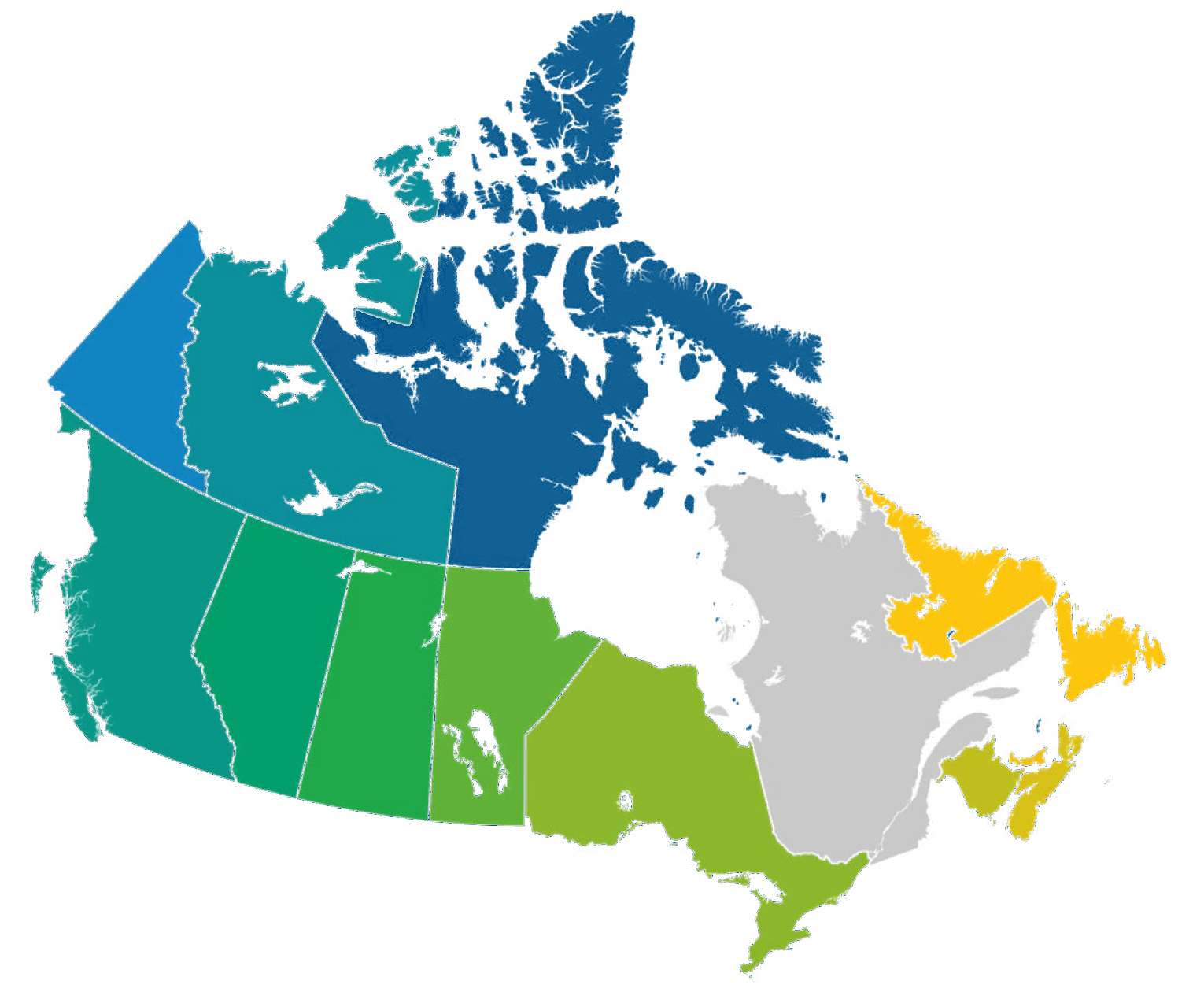
 Newfoundland and Labrador
 Nova Scotia
 Prince Edward Island
 New Brunswick
 Ontario
 Manitoba
 Saskatchewan
 Alberta
 British Columbia
 Northwest Territories
 Yukon
 Nunavut
4.1 Multilateral Early Learning and Child Care Framework
The Multilateral Early Learning and Child Care Framework establishes a common vision for the federal, provincial, and territorial governments. It aims to ensure that all children have access to high-quality learning and child care services that support their overall development. It recognizes that the early years of life are critical, and that investments in structured and regulated systems are a strategic lever for Canada’s social and economic development. The Framework is based on clear guiding principles: quality, accessibility, affordability, flexibility, and inclusion.
It explicitly emphasizes the importance of professional qualifications and workforce training in ECE as the foundation for quality services. In the context of a nationwide shortage of qualified personnel, these guidelines reinforce the relevance of mechanisms for recognizing international qualifications, which help to expand the pool of qualified staff while respecting provincial and territorial regulatory requirements.
The Framework also recognizes Canada’s linguistic and cultural diversity, including the needs of Francophone minorities, newcomers, and vulnerable families, and this places particular importance on the effective integration of internationally trained individuals.
4.2 Evaluation agencies: list, costs, timeframes, advantages, and challenges
In Canada, assessment agencies are primarily divided into two types: the evaluation of international qualifications for immigration/work, and impact assessments for industrial projects. Organizations listed by Immigration, Refugees and Citizenship Canada (IRCC) (e.g., World Education Services or WES) evaluate qualifications, while the Impact Assessment Agency of Canada (IAAC) reviews large projects. This study focuses on the first type: the evaluation of international qualifications for immigration/work.
In all cases, the process is lengthy and can take from two to five months. This depends on the complexity of the case and whether the documentation is complete. WES is the agency most often used by the provinces and territories and, in some cases, is the only agency that is accepted.
The main qualification evaluation agencies for Educational Credential Assessments (or ECAs) for immigration (outside Quebec):
World Education Services (WES)
This social non-profit organization supports the educational, economic, and social inclusion of immigrants, refugees, and international students. Commonly and predominantly used in Canada, this organization offers the following reports for education, careers, and immigration:
- Document-by-Document Evaluation Report: for Canadian-recognized qualifications, starting at $133;
- Course-by-Course Evaluation Report: for Canadian equivalencies, course lists with credits, and grades according to Canadian standards, starting at $242;
- Educational Credential Assessment (ECA) for IRCC: Evaluation of qualifications obtained outside Canada, valid for five years, starting at $264.
The candidate can choose to include the organization that is recruiting them in the list of recipients of their evaluation, subject to an additional fee.
Comparative Education Service (CES)
The Comparative Education Service (CES) at the University of Toronto evaluates, starting at $175:
- qualifications obtained from post-secondary institutions (universities and colleges) outside Canada;
- high school (secondary school) diplomas obtained outside Canada;
- high school (secondary school) diplomas issued by the provincial/territorial ministries of education outside Ontario.
The CES may be able to evaluate ongoing study programs, but only for general use applications.
The CES does not evaluate:
- professional licenses and certifications, including those obtained as part of university studies (e.g., a Certificatul de Absolvire [certificate of completion of studies] issued by a teacher training department or a pedagogical seminary);
- transition programs, bridging programs, or preparatory programs.
International Credential Assessment Service of Canada (ICAS)
The ICAS prepares reports to help employers, educational institutions, immigration officials, and community organizations better understand education received outside of Canada.
An Assessment Report, starting at $215, describes completed post-secondary (college/university) studies outside of Canada and, for each credential, suggests a comparable level in Ontario/Canada. The report also provides a list of completed courses/subjects along with comparable credits and grades.
International Credential Evaluation Service (ICES)
This international credential evaluation service is mandated by the province of British Columbia, but serves the interests of all internationally educated individuals across Canada. It authenticates documents, conducts research based on well-established methodologies, and then publishes an evaluation report that provides a recommendation on the comparability of studies completed outside Canada with the Canadian education system.
Starting at $150, ICES compares foreign qualifications to the Canadian education system; the reports offer a general comparison of years and levels of study. Its recommendations are based on several factors, including:
- the minimum qualification required for admission to the program;
- the level and duration of the program;
- the program of study to which the qualification would grant access to in the country of origin;
- the recognition of the institution and the program.
The ICES does not evaluate the content of courses and does not comment on the quality of individual qualifications.
4.3 Provincial and territorial requirements for ECE
4.3.1 Newfoundland and Labrador
a. Authority
The Association of Early Childhood Educators of Newfoundland and Labrador (AECENL) is a professional organization for individuals who have a professional qualification in early childhood education (ECE) or who are working in child care or related fields. It administers, on behalf of the provincial government, the certification of individuals who wish to work in regulated child care settings. It also advocates for the interests of early childhood educators in Newfoundland and Labrador and provides professional development opportunities, orientation courses for certification in a particular classification, bursaries, and grants (on behalf of the Department of Education and Early Childhood Development).
The Child Care Services Certification (CCSC) is a requirement for working in a regulated setting. The provincial system is based on the recognition of post-secondary training in early childhood education and on the assignment of a level and, where necessary, a classification according to age group or type of setting.
b. Levels
The system comprises five certification levels based on the duration and type of post-secondary education in ECE:
- Trainee: This level is awarded to individuals who do not yet have a recognized professional qualification in ECE. Additional training or orientation may be required;
- Level One: Generally, corresponds to a one-year post-secondary certificate in ECE;
- Level Two: Generally, corresponds to a two-year post-secondary diploma in ECE;
- Level Three: May be granted following a three-year diploma in ECE, a two-year diploma in ECE combined with a post-diploma ECE specialization, or a one-year certificate in ECE combined with a recognized four-year degree;
- Level Four: Generally, corresponds to a four-year degree in ECE, or to certain combinations of training, including a two-year diploma in ECE combined with a recognized four-year degree.
The education must have been obtained from a recognized post-secondary educational institution.
c. International recognition
For individuals trained abroad, the province evaluates post-secondary studies related to ECE. Simply holding a qualification in a related field is not automatically sufficient. It must be demonstrated that the content of the training, the program duration, and any internships or practical training completed as part of post-secondary studies meet provincial requirements.
The system also includes a classification based on age groups or practice settings, specifically for infants, preschoolers, school-aged children, pre-kindergarteners, or certain family settings. Some classifications require additional post-secondary courses or AECENL-approved orientation courses.
d. Comparative evaluation
Internationally trained applicants must provide a comparative evaluation of their studies conducted by WES or by an organization recognized by the Canadian government. This evaluation is in addition to the submission of qualifications, transcripts, course descriptions, and information on the number of hours of educational training, internships, or practical training.
If the documents are not in English, an official translation must be provided. The contact information for the post-secondary institution must also be included in the application to allow for necessary verifications.
e. Process
The process begins with the submission of a complete initial application. The applicant must submit all required documents in a single package. Once the package is deemed complete, the initial evaluation is generally carried out within 5 to 7 business days, although processing may take up to 50 business days, depending on the complexity of the application.
After review by the AECENL, the decision is approved by the relevant provincial authority. The applicant then receives written confirmation specifying their level and classification.
f. Outcomes
Two main outcomes are possible. Certification may be granted, with the issuance of a certificate number and written confirmation, or denied if the requirements are not met. If the applicant does not meet the certification requirements, an evaluation letter outlining the next steps will be sent to them.
The initial certificate is free. A fee is charged only for issuing a certificate in an 8.5 x 11 inch format, as specified in the initial application.
4.3.2 Nova Scotia
a. Authority
In Nova Scotia, the classification of early childhood educators falls under the jurisdiction of the Department of Education and Early Childhood Development. Anyone who wishes to work in a licensed child care centre must obtain a classification certificate corresponding to their training.
The certificate determines the role that the person can play in that environment, and establishes a common framework for the professional qualifications of ECE staff in the province.
b. Levels
The classification system comprises three main levels:
- Level 1: For individuals who have completed a recognized part of an ECE program and possess guided practical experience;
- Level 2: Generally granted to individuals holding an ECE diploma from a recognized post-secondary institution, often approximately two years in duration;
- Level 3: Granted to individuals holding a bachelor’s degree in ECE or a related eligible field, or a diploma equivalent to Level 2 and a bachelor’s degree in any discipline.
Two additional levels exist:
- Entry Level: Requires completion of the Orientation Training for Early Learning and Child Care;
- School-Age Approval: Requires a bachelor’s degree in early childhood elementary education or a post-secondary program that qualifies a person to plan and deliver developmentally appropriate programming for school-aged children.
c. International recognition
For individuals trained abroad, an equivalency assessment is required, to determine whether their training meets Nova Scotia requirements.
The assessment considers the training completed, transcripts, course and/or program descriptions, and, where applicable, any supervised practical experience. The goal is to classify the individual at the level that best corresponds to their professional qualifications.
If English or French is not the applicant’s first language, proof of language proficiency is required. Level 7 of the Niveaux de compétence linguistique canadiens (NCLC 7) is required for Levels 1 to 3.
d. Comparative evaluation
An evaluation of international qualifications is required, to establish their equivalency with Nova Scotia standards. A comparative evaluation may therefore be part of the application, and a mandatory course-by-course evaluation, conducted by an organization such as WES, must be provided if the qualification was obtained abroad.
In practice, applicants should be prepared to provide detailed academic records and, if required by the provincial ministry, an external evaluation or other documentation that makes it possible to compare the international training with provincial standards.
e. Process
Before starting work or being officially classified, the applicant must meet several basic requirements. In particular:
- Entry level: Must complete an orientation course in ECE and child care;
- Levels 1 to 3 and School-Age Approval: Must provide official transcripts, course descriptions and/or curricula, and proof of supervised practical experience.
The application also includes the standard checks required for working with children, including a criminal record check and a vulnerable sector check; this is not a condition for classification, but it is mandatory for employment.
Once classified, the individual must maintain their status by participating in professional development activities.
f. Outcomes
The individual receives a classification level corresponding to their recognized training. This level determines the role they can play in a licensed child care centre. If the documentation is insufficient or equivalency is not demonstrated, additional information may be requested.
Maintaining the classification also requires compliance with professional development requirements, including the accumulation of 30 hours of continuing education every three years.
4.3.3 Prince Edward Island
a. Authority
In Prince Edward Island, the certification of ECE staff is based on well-defined categories that are approved by the relevant provincial authority, namely the Early Learning and Child Care Board of the Department of Education and Early Years.
Their model focuses on combinations of short training, certificates, diplomas, or relevant university degrees.
b. Levels
The province provides five types of certification, each corresponding to a specific role:
- Family home child care provider: Has successfully completed a 30-hour course on infant and preschool child care and education, approved by the Board.
- School-age child care provider: Has successfully completed a 30-hour course on the care and education of school-age children, approved by the Board.
- Early childhood intern: Has successfully completed a 30-hour course, approved by the Board, in each of the following subject areas:
- child growth and development;
- child guidance;
- early childhood pedagogy.
- Early childhood associate: Has successfully completed:
- a one-year certificate program in early childhood care and education, approved by the Board; or
- a diploma or degree program related to human studies, approved by the Board.
- Early childhood educator: Has successfully completed:
- a two-year diploma or degree program in early childhood care and education, approved by the Board;
- a degree program related to human studies that incorporates a two-year diploma program in early childhood care and education, approved by the Board; or
- a degree program related to human studies and a one-year certificate program in early childhood care and education, approved by the Board.
c. International recognition
Individuals trained abroad can apply for recognition of their professional qualifications to obtain certification corresponding to the categories established in the province. Although the process might vary depending on the applicant’s situation, the provincial authority generally needs to verify whether the training obtained outside Canada is comparable to locally approved programs.
In this context, the main objective is to establish the equivalency between the international training and the provincial certification categories (e.g., intern, associate, or early childhood educator). The analysis focuses on the program duration, the level of study, and the course content. Applicants must therefore provide an evaluation of their academic qualifications, and an evaluation of each course, from an approved organization (e.g., WES).
According to guidelines generally applied in Canadian provincial systems, recognition aims to determine whether the training covers the essential areas of ECE, including child development, pedagogy, educational activity planning, and the supervision of young children. This process allows for the awarding of the most appropriate certification or, in some cases, the identification of required additional training.
d. Comparative evaluation
The comparative evaluation typically examines several elements, including program length, level of study, credits earned, and the relevance of the courses to ECE. Particular attention is paid to fundamental components such as child development, pedagogy, behaviour management, health and safety, and educational practice with young children. When the evaluation demonstrates sufficient equivalency, the corresponding certification may be awarded.
e. Process
The process essentially relies on demonstrating that the training completed corresponds to one of the certification profiles stipulated in the provincial regulations. The applicant must therefore submit documents that confirm successful completion of the relevant courses, certificates, diplomas, or degrees.
In cases where training has been undertaken abroad, it is reasonable to expect to have to provide an evaluation of academic qualifications, with an evaluation of each course and, possibly, a description of the courses.
f. Outcomes
The individual receives the type of certificate that best reflects their recognized training. This decision directly affects their placement on the salary scale. If the training does not fully meet the criteria for a higher category, the individual may be directed to a category corresponding to a more partial level of preparation.
4.3.4 New Brunswick
a. Authority
In New Brunswick, the Department of Education and Early Childhood Development oversees the professional qualifications of educators, including basic training requirements and professional development pathways offered in collaboration with the Collège communautaire du Nouveau-Brunswick.
According to the province’s Early Childhood Services Act, all of the administrators of an educational child care centre and 50% of early childhood educator staff must be trained with the minimum training requirement, which is a one-year certificate in ECE, or an equivalent training as determined by the Minister.
b. Levels
New Brunswick uses a salary scale based on two levels of ECE training:
- Entry Level (untrained staff): Individuals working in early childhood education centres without recognized professional qualifications in ECE. A 90-hour provincial training program is mandatory and must be completed after hiring;
- Level 1 (trained ECE staff): Staff members with a certificate or diploma in ECE or education recognized by the province. Staff with a university degree or its equivalent in an unrelated field may also be at Level 1 of the salary scale.
c. International recognition
Individuals who have completed training outside of New Brunswick must undertake the training recognition process with the provincial Department team. This process evaluates the training and determines whether it meets provincial training requirements.
New Brunswick has a specific requirement for early childhood educators who obtained their professional qualification outside the province: they must complete the 30-hour training Introduction en éducation de la petite enfance – Curriculum éducatif (Partie 2) after being hired. This training is offered free of charge by the provincial Department.
This requirement aims to ensure that staff trained elsewhere master the educational curriculum specific to New Brunswick, even when the person already holds a professional qualification recognized in another province, territory, or internationally.
d. Comparative evaluation
The provincial approach is based on reviewing prior training and aligning it with local pedagogical requirements. Individuals who received their training outside of New Brunswick are generally required to complete integration training covering the provincial curriculum.
A comparative evaluation may be part of the application and a mandatory course-by-course evaluation carried out by a designated / recognized organization (e.g., WES) must be provided if the qualification was obtained abroad.
e. Process
In New Brunswick, the process typically begins with an analysis of the applicant’s training to determine whether it meets provincial ECE requirements. Individuals trained outside the province or outside Canada must provide their qualifications, transcripts, and any other relevant documentation that might help to evaluate the suitability of their training.
For individuals who have obtained training internationally, the training recognition team requires that an evaluation report from a designated organization (e.g., WES) be submitted for the evaluation of the application.
f. Outcomes
Once the evaluation is complete, the applicant will receive an evaluation notice that outlines the results. If the training is deemed equivalent, the individual may be recognized as trained staff under the training requirements of the Early Childhood Services Act. If not, additional training may be recommended or required to meet the provincial requirements, such as the 90-hour training program Introduction en éducation de la petite enfance (parties 1 et 2), offered free of charge by the provincial Department.
4.3.5 Ontario
a. Authority
In Ontario, practicing the regulated profession of early childhood educator requires registration with the College of Early Childhood Educators. Anyone wishing to use the title of Registered Early Childhood Educator (RECE) must be eligible for registration with this organization.
For individuals who do not already hold recognized Ontario qualifications, entry to the profession is granted through an individual evaluation of professional qualifications. This evaluation aims to determine whether the training and experience are equivalent to the educational requirements for entry to the profession.
b. Levels
Ontario does not use multiple levels of provincial certification comparable to those of other jurisdictions. Instead, the system leads to a single form of professional registration: membership in the College as a Registered Early Childhood Educator (RECE).
Equivalency is assessed in relation to the four-semester ECE programs offered by Ontario public colleges. Certification does not correspond to a numbered level, but rather to a determination of admissibility for registration.
c. International recognition
The College assesses professional qualifications obtained outside Ontario and abroad on an individual basis. The analysis considers the nature of the qualifications, the program content, the duration of studies, and, where applicable, the combination of training and experience.
The system is not oriented to recommending specific remedial or refresher courses. Rather, it serves to verify whether, as a whole, the applicant’s background meets the requirements for entry to the regulated profession.
d. Comparative evaluation
The College conducts its own evaluation of professional qualifications based on the documents submitted by the applicant. Although the use of an external evaluation agency (e.g., WES) is not always required, it may be requested in certain cases to support a review of the application. However, the primary evaluation of qualifications remains the one carried out by the College.
e. Process
The process takes place in two phases:
- Phase 1: Minimum admissibility requirements: The College verifies that the application meets the admissibility requirements: application form, required documents, relevant post-secondary education, proof of language proficiency, and compliance with other registration requirements. The required fees must also be paid for the application to be processed;
- Phase 2: Detailed evaluation of professional qualifications: The College examines the program of study, course content, duration of training, and, if applicable, the combination of education and experience.
The processing of the application begins only when the file is complete. Once all documents are received, the evaluation generally takes several weeks, often 6 to 8 weeks, with the possibility of an extension if additional checks are required.
f. Outcomes
Following the review, the applicant may:
- be deemed eligible for registration as an RECE;
- be asked to provide additional information or documents; or
- be refused if the requirements are not met.
There is a one-time application fee and a separate registration fee. The final result determines admissibility to the profession, and not to the assignment of an intermediate level.
4.3.6 Manitoba
a. Authority
In Manitoba, the classification of early childhood educators (ECEs) is administered by the Child Care Qualifications and Training Committee, under the authority of the Department of Education and Early Childhood Learning. Individuals trained abroad can apply for an evaluation of their professional qualifications if they wish to obtain an official classification recognized in the province.
This classification determines the type of responsibilities a person can carry out in a regulated child care centre, their employment opportunities, and, in many cases, their salary level.
b. Levels
The Manitoba system clearly distinguishes between the role of a child care assistant and that of a Level II or III educator, which allows for precise placement of applicants based on the extent of their recognized training. It uses three main classification levels:
- Child Care Assistant (CCA): Entry level for individuals who do not yet meet the requirements for ECE II or ECE III. After hiring, certain additional requirements may apply, such as 40 hours of approved training, first aid and CPR certification, and security checks;
- Early Childhood Educator Level II (ECE II): Generally, corresponds to a post-secondary qualification of approximately two years in ECE or a recognized equivalent;
- Early Childhood Educator Level III (ECE III): More advanced level, generally associated with university education or in-depth training in early childhood, allowing for greater responsibilities.
c. International recognition
Individuals trained abroad must have their professional qualifications evaluated to determine their appropriate level. This evaluation not only validates the qualifications but also situates the individual within Manitoba’s professional and salary structure.
Manitoba also has transition and recognition programs that can help internationally trained individuals bridge some of the gaps between their initial training and provincial expectations.
d. Comparative evaluation
In Manitoba, a comparative evaluation of qualifications may be required when training was obtained outside of Canada. In this case, the province may request an analysis conducted by a recognized organization to determine the equivalence of the training with provincial standards in ECE.
The application for classification itself is usually free. However, fees may apply if the applicant is required to obtain an external evaluation of their academic credentials from an organization that evaluates qualifications. This requirement depends on factors such as the clarity of the documents provided, the institution of origin, and the relevance of the program completed.
This approach is relatively flexible, because the provincial authority retains the option of conducting an internal evaluation when sufficient information is available. An external evaluation can be used as needed to clarify a decision regarding the appropriate classification level.
e. Process
The process generally follows four steps. The applicant must:
- Gather their training documents;
- Submit a classification application;
- Provide a comparative evaluation, if required, if the training was completed abroad;
- Receive the corresponding classification from the province.
Processing times vary depending on the complexity of the application and the need for a comparative evaluation. The process can take from 4 weeks to 6 months.
f. Outcomes
After the evaluation, the person can be classified as:
- ECE II or ECE III, if the requirements are met; or
- Child Care Assistant, if the recognized professional qualification is insufficient for a higher classification level.
An explanatory letter accompanies the decision. If there still are classification gaps, programs for the evaluation of qualifications, recognition of prior learning in ECE programs, or supplementary training pathways can help the individual aim for a higher classification level.
4.3.7 Saskatchewan
a. Authority
In Saskatchewan, ECE certification falls under the jurisdiction of the Ministry of Education. The province uses a three-level certification system that allows individuals to be placed according to the extent of their recognized post-secondary ECE training.
The framework applies to people already present in the province, as well as to those who wish to prepare their application before immigration, in particular by means of a pre-approval of professional qualifications.
b. Levels
Saskatchewan offers three levels of certification:
- ECE Level I: Entry level, based on a minimum of 9 credits, i.e., 3 ECE courses. The courses usually cover child development, programming, and relationships or interactions;
- ECE Level II: Generally awarded after successful completion of the first year of a two-year diploma or equivalent (39 credits) course of study in a related area. Practicums are not considered, unless they are practical internships integrated into an ECE program. For those trained abroad, this is an intermediate level based on a certificate or more extensive ECE training; it may include more comprehensive post-secondary training and internships;
- ECE Level III: Advanced level, generally awarded after a full diploma in ECE or recognized equivalent training.
c. International recognition
A person may apply for certification if they reside in Saskatchewan, have completed early childhood education courses, hold a certificate or diploma in ECE, or have an equivalent combination of recognized training (81 credits).
For individuals living outside Canada, it is possible to obtain pre-approval of the professional qualifications (e.g., as part of a provincial immigration project or a conditional job offer in a regulated child care centre). The ECE certificate will be issued when the applicant provides proof of residency in Saskatchewan.
d. Comparative evaluation
In Saskatchewan, individuals trained abroad must provide a comparative evaluation of their qualifications to facilitate a review of the equivalency of their training. This evaluation can be conducted by a recognized organization that evaluates qualifications and is often required when the training was obtained outside Canada. Official transcripts must also be submitted directly by the post-secondary institution or included in the evaluation report to ensure their authenticity.
The comparative evaluation allows the provincial ministry to verify several elements, including the relevance of the ECE training, the duration of studies, the recognition of the institution, and the alignment of the training with provincial standards. This analysis is used to determine the appropriate level of certification and to establish whether additional training is required.
e. Process
The process typically begins with a comparative evaluation of the international qualifications. The individual then submits an application for ECE certification and provides their transcripts, diplomas, and other required documents. The provincial ministry then conducts the analysis and assigns the corresponding certification level.
When the situation warrants it, the individual may receive a pre-assessment before arriving in Saskatchewan. In other cases, certification is applied for after they have settled in the province.
f. Outcomes
The expected outcome is the awarding of a certification level, from ECE I to ECE III, depending on the extent of the recognized training. If the training is insufficient for a higher level, the individual may need to take additional courses to meet that level.
The system is organized and particularly useful for people trained abroad who want to know in advance the requirements for entry into the provincial labour market.
4.3.8 Alberta
a. Authority
The Government of Alberta has the legislative authority to certify child care centre staff under the Early Learning and Child Care Act and the Early Learning and Child Care Regulation.
A provincial certification guide specifies the minimum training standards for each certificate.
b. Levels
The Alberta system is based on three main certificates and on detailed conditions related to the training and the language of instruction of the program followed.
- Level 1: Corresponds to the entry level. It can be obtained after successful completion of the provincial ECE orientation course, a post-secondary course of approximately 45 hours related to child development, or a recognized family child care training program;
- Level 2: Generally, requires successful completion of a post-secondary program in Alberta of approximately one year leading to an ECE certificate, or training that is deemed to be equivalent;
- Level 3: Corresponds to the advanced level. It usually requires a two-year post-secondary ECE diploma from Alberta, or recognized training that is equivalent.
Language proficiency requirements may apply when the training has been completed in a language other than French or English.
c. International Recognition
In Alberta, recognition of professional qualifications obtained abroad is primarily based on an evaluation of the equivalency of the training compared to provincial requirements. Internationally trained individuals must demonstrate that their program of study meets the level required for any certification sought. This analysis may include a comparison using the provincial equivalency tables, as well as a review of course content, program duration, and practice components of the training.
When post-secondary training has been completed in a language other than French or English, the province may require proof of language proficiency. In this case, a minimum score on the Niveaux de compétence linguistique canadiens may be required. These requirements are an integral part of the process for obtaining a Level 2 or Level 3 certification and are designed to ensure the applicant’s ability to work in a regulated educational environment.
d. Comparative evaluation
Alberta’s approach does not rely on a systematic requirement to refer to a single external organization such as WES. Instead, evaluation is based on an analysis of the equivalency of professional qualifications according to provincial criteria. The provincial ministry directly reviews the submitted documentation, including transcripts, course descriptions, and records of practical training.
e. Process
The applicant must gather records of their training and demonstrate that their training pathway meets provincial criteria. For Level 2 or 3 certificates, this involves demonstrating either successful completion of a recognized program, or a record of equivalent training.
f. Outcomes
The individual receives the certificate corresponding to the recognized level of training (Level 1, 2, or 3). If the application does not support a higher level, the applicant may receive a lower certificate that corresponds to the training that was demonstrated, or be required to provide additional documents or records.
4.3.9 British Columbia
a. Authority
In British Columbia, certification is administered by the Early Childhood Educator (ECE) Registry, with several distinct professional certificates, rather than a simple numbered level system.
This model makes it possible to distinguish between basic professional qualifications, full certificates, and certain specializations, including specializations for infants and toddlers or for children with special needs.
b. Levels
In British Columbia, the different types of professional certifications determine the responsibilities that can be carried out in regulated child care centres:
- Responsible Adults (RAs): Although this certificate is not administered by the ECE Registry, individuals who wish to work with school-aged children must provide proof of at least 20 hours of training in child development, guidance, health and safety, or nutrition. They can obtain a Responsible Adult certificate from various training providers;
- Early Childhood Educator Assistant (ECEA): This entry-level certificate allows an individual to work under the supervision of a certified educator. It can be obtained after successfully completing one or more basic ECE courses, particularly those related to child development, guidance, or health and safety;
- Early Childhood Educator (ECE): This certificate is the primary professional qualification that allows individuals to assume full educational responsibilities. It is generally awarded after successful completion of a recognized ECE program of one or five years, depending on the number of supervised work hours completed by the applicant prior to application. The five-year certification requires, in particular, demonstration of supervised work experience, including a minimum number of practice hours, as well as references that can attest to professional competencies;
- Additional Specializations: British Columbia also offers specialized certificates, including certificates for Infant and Toddler Educators and Special Needs Educators. These specializations require additional training that focuses on specific age groups or on working with children with special needs. They allow for expanded professional responsibilities and access to certain specialized positions, including working with children under 36 months old.
Certifications must be renewed regularly (annually or every five years) by showing at least 40 hours of professional development and confirming work experience.
c. International recognition
Individuals trained abroad must submit their professional qualifications for evaluation by the provincial authority. An application typically includes official transcripts, a description of the program completed, confirmation from the training institution, and any other relevant academic or professional documents. This information allows for an analysis of the length of studies, the content of the training, and a record of a practice component. All documents must be submitted in English or accompanied by a translation.
The goal of this process is to determine which type of certificate the applicant is eligible for, whether additional training is required, and, where appropriate, whether the applicant can attain specialized certificates. The analysis aims to establish the equivalency between the training obtained abroad and the requirements of the British Columbia certification system.
d. Comparative evaluation
In British Columbia, qualifications obtained abroad must undergo a comparative evaluation by a recognized organization. The International Credential Evaluation Service (ICES), offered by the British Columbia Institute of Technology (BCIT), is used for this. This external evaluation aims to provide a structured analysis of the level of education and the equivalency of training.
The evaluation report allows the ECE Registry to compare the training received abroad with provincial ECE requirements. Based on this analysis, the authority can determine whether the individual is directly eligible for a certificate, or needs to complete additional training, or can attain specialized certification.
e. Process
The process begins with identifying the desired certificate. The applicant then submits an application, including their educational and professional documents, to the ECE Registry, which then evaluates the equivalency and determines the applicable certificate.
In addition to training, further requirements may apply depending on the certificate sought, including proof of supervised work experience, professional references, a background check, and first aid certification.
f. Outcomes
Outcomes of this process can include an award of the certificate corresponding to the recognized level, either ECE Assistant, ECE, or ECE with additional specializations.
British Columbia also recognizes certain certifications from several other provinces/territories, but it converts them into equivalent provincial certificates. In this way, a lower-level certification may lead to an Early Childhood Educator Assistant certificate, while a higher-level certification may lead to an ECE certificate, depending on demonstrated work experience.
4.3.10 Northwest Territories
a. Authority
In the Northwest Territories, the certification of ECE staff falls under the jurisdiction of the Department of Education, Culture and Employment. Individuals trained abroad can submit their professional qualifications to obtain certification that is recognized within the territory.
The model adopted is relatively flexible and relies primarily on a direct analysis of academic documents by the territorial authority. This approach makes it possible to evaluate the equivalence of training obtained outside the territory and to award the most appropriate certification, while also identifying, if necessary, any additional training required.
b. Levels
The territorial system generally distinguishes between three professional categories corresponding to different levels of responsibility, depending on the recognized training. This classification system determines the functions that can be performed in regulated child care centres, as well as the opportunities for professional advancement.
The three levels generally held are as follows:
- Early Learning and Child Care Assistant (ELCCA): Entry level that can be granted to a person with little or no formal training. It allows them to work under supervision;
- Early Learning and Child Care Educator (ELCCE): Intermediate level requiring post-secondary training in early childhood education, often comparable to a certificate or partial training;
- Early Learning and Child Care Supervisor (ELCCS): Advanced level associated with more comprehensive qualifications in ECE and with supervisory or management roles.
c. International recognition
Individuals trained abroad can apply for certification by submitting their post-secondary qualifications, transcripts, course descriptions, and any other relevant documentation. The territorial ministry then evaluates the length of studies, the content related to early childhood, the training institution, and the equivalency with territorial standards.
This method allows the person to be placed within the assistant, educator, or supervisor levels, according to the extent of their recognized training.
d. Comparative evaluation
In the Northwest Territories, having an external comparative evaluation, such as that offered by WES, is not systematically mandatory. The territorial authority may directly analyze the academic documents submitted by the applicant to determine the equivalence of their training with territorial ECE requirements.
The territorial ministry typically reviews official transcripts, qualifications, course descriptions, and any information related to program duration and practical training components. This review aims to verify the relevance of the training, the recognition of the educational institution, and their equivalency with territorial standards for each certification level.
When the information provided is deemed insufficient or difficult to interpret, the authority may request a comparative evaluation by a recognized organization to support its decision. This process allows for a more detailed analysis of the level of studies and the equivalency of the program completed.
This approach offers a degree of flexibility to those trained abroad, while requiring that submitted documents be complete, clear, and sufficiently detailed to allow for a rigorous evaluation. It also allows the process to be adapted to the diversity of different international training pathways.
e. Process
The applicant first completes the application for ECE certification, then submits their qualifications, transcripts, and, if requested, course descriptions. The territorial ministry then reviews the application and determines the appropriate certification level.
If necessary, the territorial authority may request additional documents or recommend further training before confirming the decision.
f. Outcomes
The outcome of the process is the awarding of a certification level corresponding to the recognized training. The individual can then be classified as an assistant, educator, or supervisor, depending on the extent of their background and experience.
When the application does not make it possible to clearly establish equivalency or reveals significant training gaps, additional documents or supplementary training may be required.
4.3.11 Yukon
a. Authority
In the Yukon, staff working in a licensed ECE and child care program must hold an ECE certification issued by the Early Learning and Child Care Branch of the Department of Education.
The territory’s system is notable for its very detailed graduated structure, which allows for the recognition of different stages of progression in post-secondary training.
b. Levels
The Yukon provides five levels of certification:
- Level 1: Obtained after one course of 60 hours on early childhood development, the course “Understanding the Early Years” from the Yukon First Nations Education Directorate, or equivalent recognized training;
- Level 1A: Obtained after five courses or 15 post-secondary credits in early childhood development, or equivalent recognized training;
- Level 2: Obtained after one year of post-secondary training in early childhood development, or equivalent recognized training;
- Level 2A: Obtained after 15 courses or 45 post-secondary credits, or equivalent recognized training;
- Level 3: Obtained after two years of post-secondary training in early childhood development, or equivalent recognized training.
c. International recognition
In the Yukon, recognition of professional qualifications obtained outside the territory or outside Canada is based on an evaluation of the equivalence of the training to territorial requirements for early childhood education. Individuals trained abroad may therefore be evaluated based on the number of courses taken, the number of credits accumulated, the level of the program, and the relevance of the content in relation to key areas of early childhood education.
The analysis typically focuses on a report provided by an evaluation agency, course descriptions, the duration of the training, and whether or not there is a practical component to the training. A transcript may be requested for clarification. This process aims to determine which Yukon certification level can be associated with the training and whether any additional requirements apply.
The Early Childhood Educator Guide to Certification is the primary reference for evaluating equivalencies. It identifies recognized training programs and clarifies the equivalency between professional qualifications obtained elsewhere and the Yukon certification levels. This approach promotes a structured recognition of international pathways while ensuring compliance with territorial standards.
d. Comparative evaluation
In the Yukon, an external, course-by-course comparative evaluation is required for anyone trained outside Canada. The territorial authority prioritizes this direct analysis of training equivalency based on the academic documents submitted by the applicant. This approach allows for the evaluation of the relevance of training with respect to the territorial requirements for ECE.
The analysis focuses on the number of courses taken, the number of credits earned, the program content, and whether or not there is a practical component to the training. Detailed course descriptions and any supplementary documentation are used to determine the equivalency with Yukon certification levels.
When the information provided is insufficient or difficult to interpret, the territorial authority may request additional documents (e.g., supporting documents attesting that the training completed corresponds to one of the recognized levels, or an academic transcript), in addition to the external comparative evaluation. This flexible approach allows the evaluation to be adapted to the diversity of international pathways, while maintaining territorial standards.
e. Process
The process involves submitting an application for certification and demonstrating that the training corresponds to one of the recognized levels. The evaluation will focus on the nature of the courses, the amount of post-secondary training, and, where applicable, the overall equivalency of the program completed.
The candidate must therefore be able to accurately document their background and experience, especially when their training took place outside the territory or in another country.
f. Outcomes
The outcome results in the award of a certificate for Level 1, 1A, 2, 2A, or 3. This gradation allows for the recognition of partial or complete training pathways and for adjusting the professional qualification level according to the individual’s progress over time.
In this way, the Yukon stands out for a very precise progression between ECE entry thresholds. This can be advantageous for candidates who have incomplete but significant training in early childhood education.
4.3.12 Nunavut
Nunavut is not among the jurisdictions covered by this study. No diploma requirement applies to working in early childhood education in the territory, and therefore no diploma recognition or comparative evaluation process is required. A person trained abroad who wishes to work in early childhood education in Nunavut may contact employers in the territory directly.
